Introduction
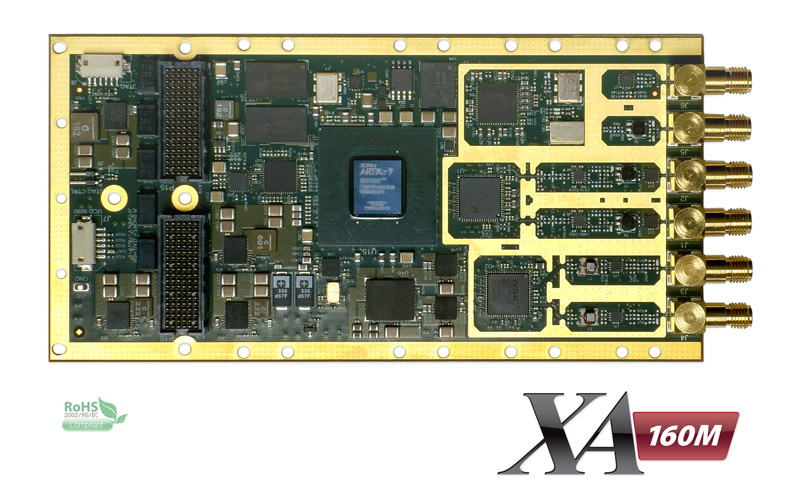
Rayleigh scattering-based distributed acoustic sensing (DAS) systems use fibre optic cables to provide distributed strain sensing. In DAS, the optical fibre cable becomes the sensing element and measurements are made, and in part processed, using an attached optoelectronic device. The XA-160M data acquisition board has been used in several commercial DAS systems to digitise the back scattered light.
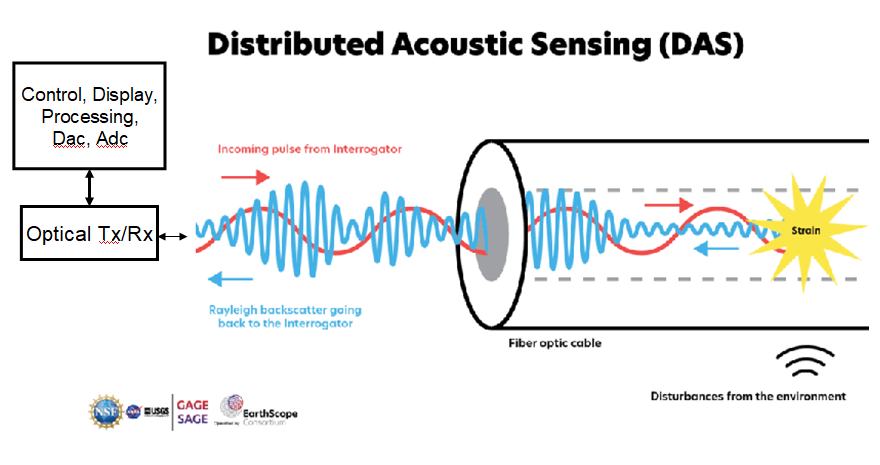
Credit: Davie Loria/EarthScope. licensed CC BY 4.0.
The figure above shows a simple Distributed Acoustic Sensing system. Pulses of light are emitted down the fibre at regular time intervals. The fibre cable is laid where movement is to be detected, eg a perimeter fence, boundary, oil & water pipelines for leaks or interference, seismic sensing etc. Tiny movements in the fibre cause a change in the light that is reflected back from small variations in the refractive index of the fibre.
The length of the cable can be upto 50km. The maximum range depends on the power of the pulse that can be transmitted and the loss of the cable. A typical loss could be 0.2dB / km. The light must travel in both directions, so that doubles the loss. Above a particular power threshold, the light experiences non linear effects in the fibre and this disrupts the operation of the system. Once the receiver has waited for light to be reflected from the whole length of the cable, another pulse can be transmitted. The length of the transmitted pulse determines the spatial resolution of the system. A longer pulse has more power and therefore greater range, but less spatial resolution. A typical 100ns pulse would give ~10m resolution.
The optical receiver converts the light to electrical energy and this is digitised at a very fast rate for digital processing. Clearly a 100ns pulse needs to be sampled at over 20MSPS to satisfy Nyquist and even faster to achieve better resolution and Signal to Noise ratio. The digitiser must capture and provide large blocks of these samples for post processing by a computer (CPU) or more typically a Graphics Processing Unit (GPU). The XA-160M is ideal for this task, having 2 channels of 16 bit 160MSPS ADC’s and a FPGA with DDR memory for triggering and data capture. Captured orthogonal samples are transported to the host via PCIe lanes. It also has dual DAC’s which can be used to generate the transmitted pulse, which helps with controlling the coherency of the system. That’s essential for accurate range calculations or frequency spectrum processing on multiple returns to analyse what is causing the interference.
The onboard FPGA has spare logic resources which can be customised for the application. Typically it is used to offload some of the front end digital signal processing, exploiting the parallel processing architecture of FPGA’s. We have provided custom trigger schemes, data formatting and trigonometric processing to some of our customers.